

Digital Visibility That Supports the Discoverability of a Specialist Company
A specialist company wanted to improve the content structure, search visibility and ability of its website to guide visitors towards the right services. The goal was not only to make the website visually functional, but to build a clearer whole where services, references, blog content and search engine optimisation support the same objective.
The work developed the website structure, service categories, reference pages, publication categories, metadata and content so that search engines can better understand what the company does and who its services are intended for.
At the starting point, there was a need to clarify the role of service pages, references and blog content in particular. At the same time, it was important to build content that serves both search engines and real customers: people looking for help with websites, search engine optimisation, digital visibility and trust-building expert content.
The work helped turn the website from a collection of individual content pages into a more consistent whole, where every page has a clear purpose, its own topic and a better opportunity to be found in search engines.
Key areas
- Website content structure
- Search engine optimization (SEO)
- Structuring service pages
- Building reference pages
- Developing digital visibility
- Google Search Console monitoring
- WordPress
What was done
The website content and structure were developed from an SEO perspective. The work examined how different parts of the website support each other and how services can be presented in a way that is understandable for both visitors and search engines.
During the work, attention was paid to ensuring that service pages, references and blog content do not compete with each other for the same keywords. Each content type was given its own role: service pages support visitors who are closer to making a purchase decision, references build trust, and the blog can reach visitors earlier in the buying journey.
- Clarifying service categories
- Editing search-friendly headings and content
- Planning SEO titles and meta descriptions
- Structuring content with H1, H2 and H3 headings
- Monitoring the development of search visibility
- Editing content according to customer search intent
Technical approach
The technical approach was based on reviewing the website structure, content and search visibility as one connected whole. SEO was not treated as a separate add-on, but as part of the overall website design.
The key areas included:
- clear URL paths and slugs
- consistent publication categories
- search-friendly headings
- unique meta descriptions
- separating service pages and references from each other
- internal linking between content
- monitoring Google Search Console metrics
- developing pages based on search results and search intent
The work also took into account that search engine optimization is not just about adding keywords to text. More importantly, the aim was to build a website where topics are clearly structured, content answers the right questions and visitors can quickly find the next sensible step.
Website structure supporting discoverability
Services and references were separated into their own content areas so that the website structure supports both visitor navigation and search engine understanding.
SEO as part of the content
Search engine optimisation was integrated into headings, meta descriptions, URL paths and content structure so that every page has a clear purpose of its own.
References building trust
Customer projects were structured as individual publications so that expertise becomes visible through concrete examples.
Forms and data protection considered from the beginning
Contact forms and possible job application forms were planned so that the collection of personal data, purpose of use and privacy policy are a clear part of the whole.
A cookieless implementation reduced data protection risks
The website was implemented without visitor tracking cookies, keeping the user experience clear and the data protection perspective simpler.
Development was monitored with data
Google Search Console data was used to monitor the website’s discoverability so that content can be developed based on search results and user search intent.
Outcome
As a result of the project, the website gained a clearer structure, stronger content areas and a better foundation for developing search visibility.
Services, references and blog content were separated more clearly from each other. Publications were given appropriate categories and slugs, and the content was developed to better respond to customers’ searches and decision-making needs.
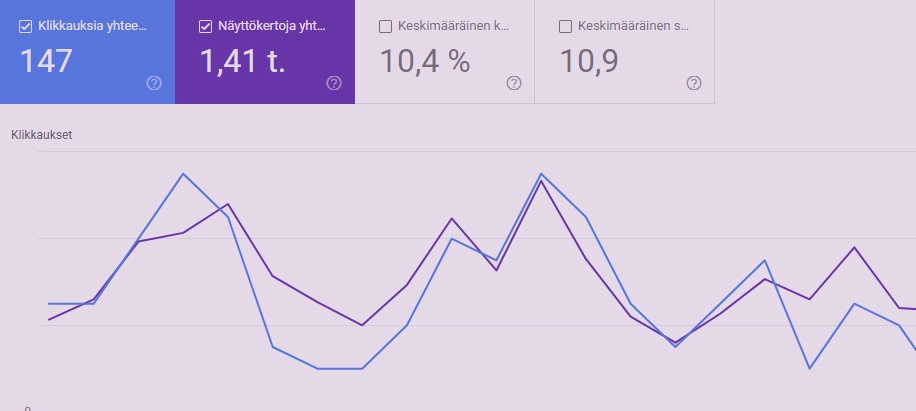
Based on Google Search Console data, the website’s organic visibility developed positively: impressions increased, clicks grew and the average position improved clearly during the review period.
The outcome was a website that is not only a digital business card, but a more discoverable, trust-building whole that guides visitors towards the right services.
During the review period of 3 months, the website received: